Research
Two measurement problems take most of my time now. The first is volatility: how rough its paths are, and in which markets that can be measured at all. The second is model fit: what the usual summary of a factor model's cross-sectional performance means once it comes with a standard error. Behind them are methods I have used since my Ph.D., stochastic control and simulation, and ones I picked up at Berkeley, causal inference on observational data, which I am now carrying back into asset pricing and into insurance.
Working papers
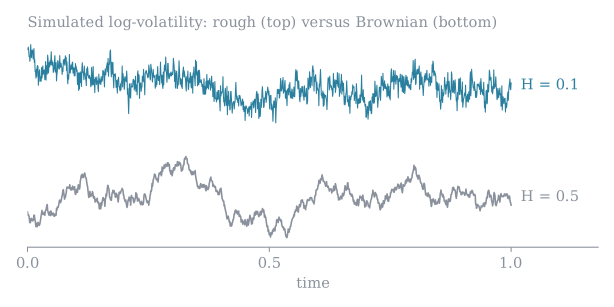
Tests the rough volatility hypothesis on the exchange-traded US universe rather than the S&P 500 alone: 3,926 equities, 34 CME futures roots, and options on 44 underlyings, through one pipeline. Realized volatility is rough in every asset class, with class medians running from 0.05 in livestock to 0.20 in equity indices. The option-implied estimator identifies the exponent only for equity indices; in rates and FX the smiles are nearly symmetric and the at-the-money skew carries no information about roughness. Range-based estimators introduce spurious roughness, which supersedes part of my 2023 paper. The paper also derives a mean-reversion contamination formula for the second-moment estimator and a two-estimator correction for additive measurement error. The practical result is about model risk: dispersion within an asset class is as wide as dispersion between classes, so a model calibrated on crude oil does not transfer to natural gas.
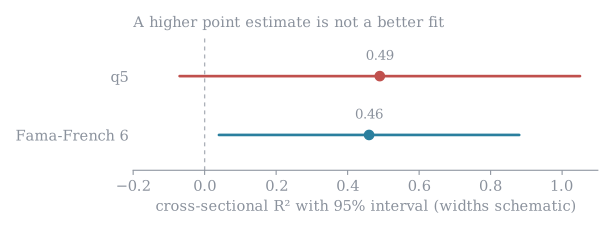
Empirical asset pricing ranks factor models by cross-sectional R², almost always without a standard error. We derive the asymptotic distribution of the statistic and of differences in fit between models, nested and non-nested, accounting for estimation error in the first pass and for misspecification. Over 684 months and 90 test portfolios, the Fama–French six-factor model is the only one of nine that rejects zero fit, at 0.46; the q⁵ model posts a higher point estimate and does not reject, because its standard error is larger. A second paper extending the framework to non-traded factors is in progress.
Estimates roughness from Parkinson and Garman–Klass range proxies, for assets where high-frequency data is not available. The cross-asset study above finds that range estimators introduce spurious roughness, so I now read this paper's Hurst estimates as biased downward; its forecasting comparison stands.
Research areas
Volatility measurement
My work on rough volatility started from option prices. With Livieri, Pallavicini, and Rosenbaum (IISE Transactions, 2018) we showed that at-the-money implied volatility on short-dated S&P 500 options supports the rough fractional stochastic volatility model, with a Hurst exponent near 0.3; the gap to the lower values found in historical data comes from smoothing over the option's time to maturity. The 2026 paper returns to the question with high-frequency data across asset classes, and spends as much effort on where the estimators fail as on where they work.
Factor models and the cross-section
The inference work above extends Kan, Robotti, and Shanken's two-pass methodology to a centered cross-sectional R², which can be negative, and derives tests for differences in fit between models. Earlier, with Lisa Goldberg at Berkeley (The Journal of Finance and Data Science, 2022), I compared machine learning methods for forecasting annual returns and maximum drawdown, and asked what ESG scores add once fundamental characteristics are controlled for. Not much, in that sample. A current project with Gareth Peters carries matching and synthetic control methods into factor models, to separate causal factor effects from association.
Causal inference and survival
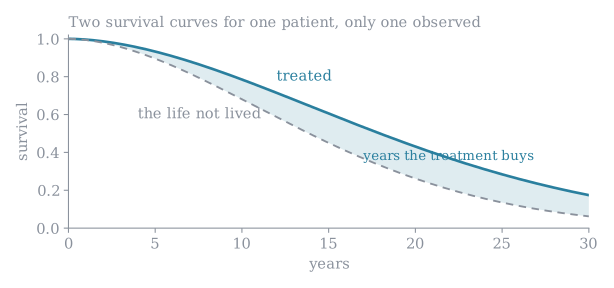
At Berkeley, with Swiss Re support and nutritionists from NNEdPro, we built the I-Rand resampling estimator for treatment effects in two-point time-series data without a parallel control group (Statistics in Biosciences, 2023), and used directed acyclic graphs to study diet and cardiovascular risk in the UK National Diet and Nutrition Survey. The current step is generative: estimate the survival a patient would have had under the treatment they did not receive, then let recorded outcomes on each path correct the model. The method has been checked against a randomized trial and applied to a national health survey. It is the same counterfactual question an insurer asks when pricing a risk factor.
Stochastic control for derivatives and insurance
My doctoral work, carried out partly at AXA, covered optimal execution of option books under market impact (Market Microstructure and Liquidity, 2016) and the pricing and hedging of variable annuities when policyholders behave optimally. Both lead to Hamilton–Jacobi–Bellman equations solved by Monte Carlo and finite differences. The insurance side is collected in a 2023 Chapman & Hall/CRC book on sustainable life insurance.
Energy, climate, and scenario generation
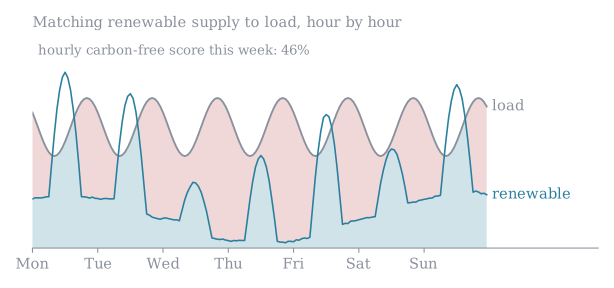
With Michael Ludkovski and Glen Swindle (IEEE PES 2024) I worked on least-cost procurement of 24/7 carbon-free electricity, a chance-constrained portfolio problem where the constraint is on the quantile of the hourly carbon-free score. The scenario generation problem inside it is the one property and casualty insurance faces when it prices catastrophic exposure: the historical record is too short to supply the scenarios the model needs. I am now building spatio-temporal generative models for renewable generation conditioned on weather fields and for catastrophic loss.
Applied work
At AXA Group Risk Management I built a variable annuity pricing system in C++ from the products' own brochures, and studied rational policyholder behavior closely enough that it changed how some of those products were designed. Other work there covered dynamic hedging of option-like guarantees under IFRS and US GAAP, capped volatility funds, and portfolio insurance. At Crosure I set up the actuarial function and the risk models behind product pricing. That work keeps the scenario generation problem concrete.
Publications
S. Mouti. Rough volatility across assets. arXiv:2608.16749, working paper, 2026.
A. Horenstein, P. Maio, S. Mouti, F. Wang. Inference on cross-sectional fit in linear factor models. SSRN 6460038, working paper, 2026.
M. Ludkovski, S. Mouti, G. Swindle. Least-cost structuring of 24/7 carbon-free electricity procurements. IEEE PES General Meeting, Seattle, 2024. arXiv:2312.07733
S. Mouti. Rough volatility: evidence from range volatility estimators. Working paper, 2023, revised 2024. arXiv:2312.01426
A. Kalife, L. Goudenège, X. Tan, S. Mouti, M. Bellmane. Sustainable Life Insurance: Managing Risk Appetite for Insurance Savings and Retirement Products. Chapman & Hall/CRC Financial Mathematics Series, 2023.
X. Dai, S. Mouti, M. Lima do Vale, S. Ray, J. Bohn, L. Goldberg. A resampling approach for causal inference on novel two-point time-series with application to identify risk factors for type-2 diabetes and cardiovascular disease. Statistics in Biosciences, 2023.
C. R. Tramontt, S. Mouti, M. Lima do Vale, X. Li, C. Delon, S. Armes, R. Golubic, S. Ray. Do markers of adiposity and glycaemia mediate the association between low carbohydrate diet and cardiovascular risk factors: findings from the UK NDNS 2008–2016. BMJ Nutrition, Prevention & Health, 2023.
L. Goldberg, S. Mouti. Sustainable investing and the cross-section of returns and maximum drawdown. The Journal of Finance and Data Science, Vol. 8, 2022.
M. Lima do Vale, L. Buckner, C. G. Mitrofan, C. R. Tramontt, S. K. Kargbo, A. Khalid, S. Ashraf, S. Mouti, X. Dai, D. Unwin, J. Bohn, L. Goldberg, R. Golubic, S. Ray. A synthesis of pathways linking diet, metabolic risk and cardiovascular disease: a framework to guide further research and approaches to evidence-based practice. Nutrition Research Reviews, 2021.
G. Livieri, S. Mouti, A. Pallavicini, M. Rosenbaum. Rough volatility: evidence from option prices. IISE Transactions, Vol. 50, No. 9, 767–776, 2018.
A. Kalife, G. López Ruiz, S. Mouti, X. Tan. Optimal behavior strategy in the Guaranteed Minimum Income Benefit product. Insurance Markets and Companies, Vol. 9, 41–69, 2018.
A. Kalife, S. Mouti. On optimal options book execution strategies with market impact. Market Microstructure and Liquidity, Vol. 6, Issue 3, 2016.
A. Kalife, S. Mouti, X. Tan. Minimizing the market impact of hedging insurance liabilities within risk appetite constraints. Insurance Markets and Companies, Vol. 6, Issue 2, 2015.
L. Wang, A. Kalife, X. Tan, B. Bouchard, S. Mouti. Understanding guaranteed minimum withdrawal benefit: a study on financial risks and rational lapse strategy. Insurance Markets and Companies, Vol. 6, Issue 1, 6–21, 2015.
A. Kalife, L. Goudenège, S. Mouti. Managing gap risks in iCPPI for life insurance companies: a risk-return cost analysis. Insurance Markets and Companies, Vol. 5, Issue 2, 2014.
A. Kalife, S. Mouti, L. Wang. Financial risk management and the rational lapse strategy in life insurance policies. Insurance Markets and Companies, Vol. 4, Issue 2, 2013.